A legal proceeding can move quickly. Questions are asked, answers follow, attorneys raise objections, exhibits are identified, and several people may speak within a short period of time. While attention is often focused on the attorneys and witnesses, another professional is concentrating on something equally significant: capturing what is said.
That responsibility belongs to the court reporter. Court reporting requires sustained concentration, command of specialized equipment, familiarity with legal terminology, and the ability to follow spoken exchanges as they occur. The finished transcript may eventually appear orderly on the page, but producing that record begins in an environment that is often active and unpredictable.
Looking more closely at the work reveals what happens between the spoken proceeding and the written record that follows.
More Than Recording Words
It is easy to describe court reporting as converting speech into text. That description, however, leaves out much of what occurs during an actual proceeding. A reporter must distinguish among speakers, follow questions and answers, capture objections, recognize terminology, and remain attentive when the pace of conversation changes.
Names, dates, addresses, technical expressions, medical terminology, numbers, and references to exhibits may all arise during testimony. In some proceedings, the subject matter can shift quickly. The reporter is therefore doing more than listening for individual words. The reporter is following the proceeding as it unfolds and creating a record that can later be read and understood.
When the Record Begins
Before testimony starts, the reporter may need information concerning the participants, case, attorneys, witness, or proceeding. Depending on the setting, appearances may be identified and preliminary information placed on the record. Once testimony begins, the reporter’s attention turns to capturing the spoken exchange.
In a deposition, for example, an attorney may ask a question and the witness responds. Another attorney may object before the answer is complete. The questioning attorney may then continue, clarify the question, or move to another subject. To someone listening casually, the exchange may simply sound like conversation. For the reporter, every speaker and statement must be followed carefully.
The distinction becomes particularly apparent when people speak at the same time. Human conversation naturally includes interruptions and overlapping speech. A written transcript, however, needs to communicate who said what. This is one reason orderly speaking habits matter during recorded proceedings.
Keeping Pace With Live Testimony
Court reporters work in real time. The proceeding continues as questions are asked and answers are given, which means the reporter must continue capturing the exchange as it occurs.
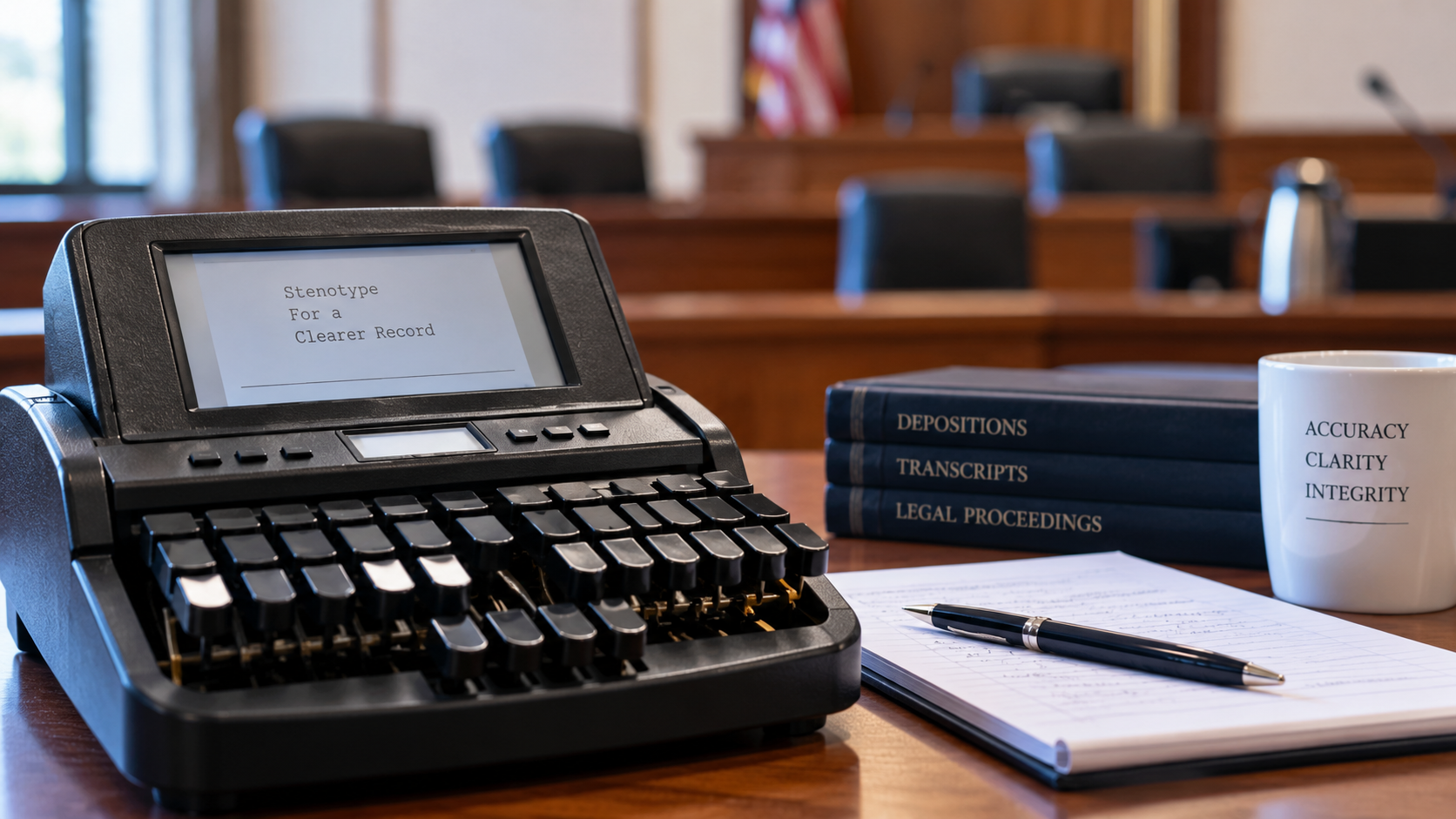
Modern stenographic methods allow trained reporters to capture speech at speeds that would be impractical using an ordinary keyboard. Rather than typing every word letter by letter, stenographic systems allow sounds, words, phrases, and combinations of language to be recorded through specialized keystrokes. Computer aided transcription software can then translate those strokes using dictionaries associated with the reporter’s writing system.
Technology is an important part of the process, but it does not eliminate the reporter’s judgment or concentration. A proceeding may contain unfamiliar names, specialized vocabulary, acronyms, unusual pronunciations, or words that sound alike. Context remains important, and the reporter must continue following the speakers while managing these details.
When the Spoken Record Is Unclear
Not every statement made during a proceeding is easy to hear. A person may speak quietly, someone may turn away while answering, two participants may begin talking simultaneously, or background noise may interfere with speech. A witness may also respond with a gesture rather than a verbal answer. These situations present an obvious challenge when the goal is a written record.
A nod might communicate meaning to everyone sitting in the room, for example, but a gesture alone does not provide a spoken answer for the transcript. Reporters may need clarification when something cannot be heard or understood sufficiently to capture it. Participants may also be reminded to speak one at a time or provide a verbal response.
These moments illustrate an important distinction between being present for a conversation and preserving that conversation in written form. The transcript needs to remain understandable after the proceeding has ended.
Following Different Speakers
Speaker identification is another basic part of producing a readable record. A deposition might involve a witness, examining attorney, opposing counsel, and additional participants. A hearing or trial can involve an even larger group. The reporter needs to follow who is speaking throughout the proceeding so that the eventual transcript properly attributes statements.
This becomes more demanding when exchanges accelerate. Objections can interrupt questions, attorneys may address each other, and a witness may begin answering before a question has been completed. In a courtroom, a judge may enter the discussion while attorneys are presenting arguments. The reporter remains focused on the sequence of speech while the rest of the proceeding continues around them.
Exhibits and the Proceeding
Documents, photographs, correspondence, diagrams, contracts, reports, and other materials frequently become part of legal proceedings. During a deposition, an attorney may introduce a document and ask that it be marked as an exhibit. The witness may then be questioned about particular portions of that material.
The reporter tracks what occurs on the record concerning those exhibits. Exactly how exhibits are handled can vary according to the proceeding and circumstances, particularly when participants are appearing remotely. Electronic exhibit platforms have also changed how documents can be introduced and distributed in virtual settings.
Regardless of format, exhibits and testimony often need to remain clearly connected. A later reader should be able to follow the transcript and recognize when the discussion moved to a particular piece of evidence.
From Spoken Testimony to a Transcript
The end of a proceeding does not necessarily mark the end of the reporter’s work. The captured record must ultimately become a transcript when one is requested or required. That process can involve reviewing translated stenographic notes, checking terminology, confirming names or spellings, examining formatting, and addressing portions of the text that require closer attention.
Punctuation also matters because spoken language does not arrive neatly divided into sentences and paragraphs. People change direction while speaking, pause, restart sentences, repeat themselves, and sometimes leave thoughts unfinished. A transcript must represent what occurred while presenting the proceeding in a readable format consistent with applicable requirements.
The result is a document that attorneys and other authorized participants can use after the voices in the room have gone silent.
Court Reporting Beyond the Courtroom
The name of the profession can create the impression that reporters spend all of their time inside courtrooms. In practice, court reporting can take place in many settings. Depositions are one familiar example, but reporters may also work during hearings, arbitrations, examinations, meetings, and other proceedings where a verbatim record is required.
Some assignments take place in conference rooms. Others occur inside courthouses, government facilities, offices, or through remote video platforms. The physical setting may change considerably, but the central task remains connected to capturing spoken proceedings accurately and producing a usable record.
Technology Has Changed the Setting
Court reporting has evolved alongside communications technology. Remote depositions have allowed attorneys, witnesses, reporters, and other participants to attend from separate locations. Electronic exhibits can be displayed and distributed without everyone sitting around the same conference table.
Realtime reporting provides another example. With realtime technology, stenographic notes can be translated into text as the reporter writes, allowing authorized participants to view testimony on a screen while it is occurring.
These tools have changed how legal professionals can interact with the record, while also introducing different practical concerns. Audio quality, internet connections, microphones, speaker identification, remote exhibit handling, and participant behavior can all affect the reporting environment. The equipment may evolve, but the need for a clear record remains.
A Profession Centered on the Record
Much of a court reporter’s work occurs without drawing attention. During testimony, the reporter is rarely the person everyone has come to hear. During a deposition, attention is directed toward the witness and attorneys. During a hearing, the focus may be on the judge, arguments, or evidence.
Yet once the proceeding is over, the reporter’s work can become one of its most enduring products. The transcript allows people to return to testimony after the moment has passed. Questions can be examined again, answers can be located, and objections and statements can be reviewed in the sequence in which they occurred.
That written record begins with someone paying close attention while everyone else is speaking. For court reporters, that is where the work starts.