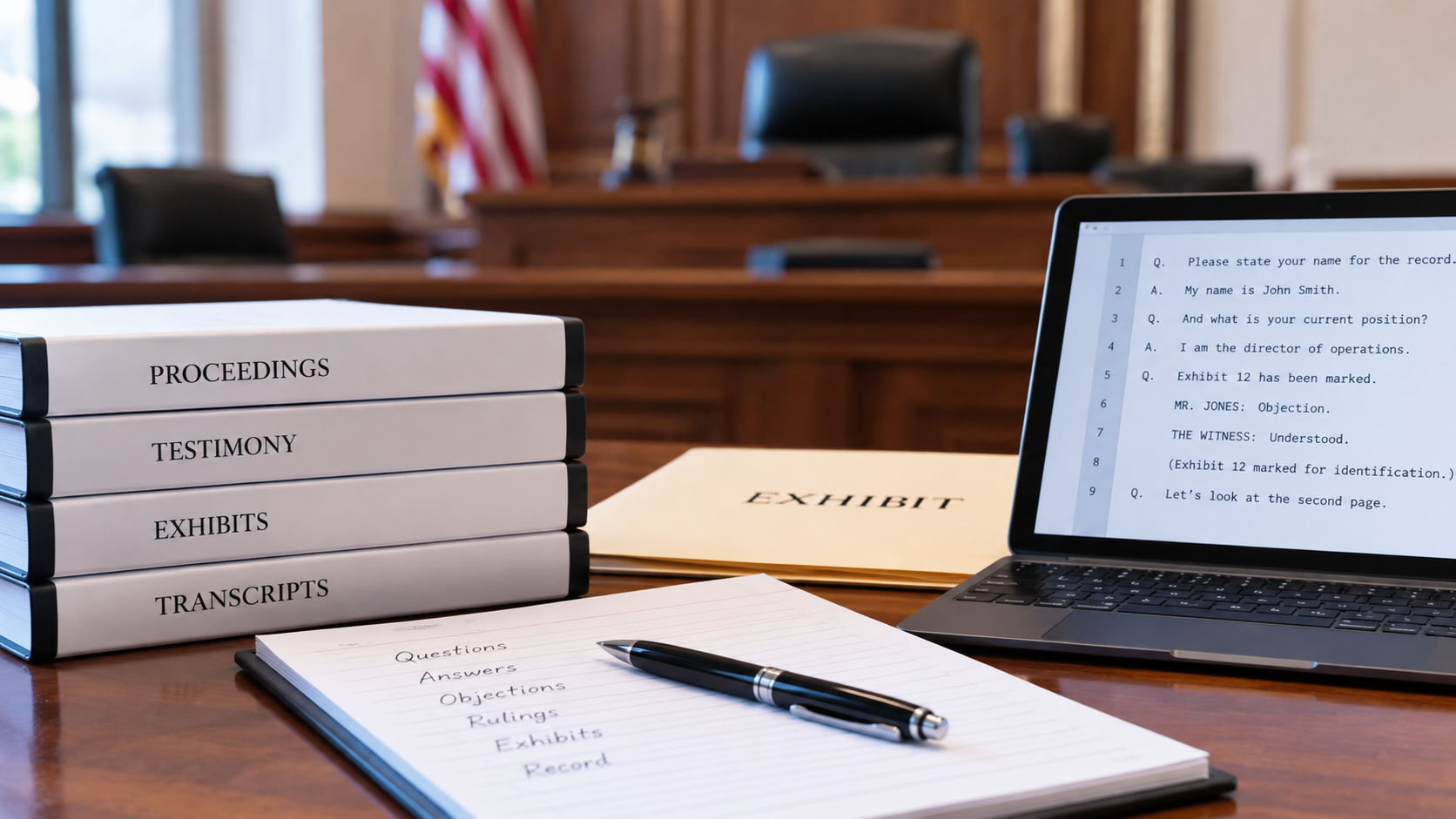
A legal proceeding begins with spoken words, but what remains afterward is often a written record. Questions, answers, objections, rulings, and references to exhibits may eventually appear together in a transcript that allows readers to revisit what occurred. Creating that record is not simply a matter of collecting everything that can be heard in a room. Legal proceedings involve multiple speakers, formal procedures, interruptions, specialized terminology, and moments when the meaning of an exchange depends on identifying exactly who said what.
The court reporter follows these elements as they happen and captures the proceeding in a form that can later be prepared for review. The process becomes easier to appreciate by looking at how the record develops from the opening moments of a proceeding through its conclusion.
Establishing Who Is Present
Before substantive testimony begins, the participants and nature of the proceeding may need to be identified. Attorneys can state their appearances, the witness may be identified, and other preliminary information may be placed on the record. These opening details provide context for everything that follows. A transcript containing hundreds of pages of testimony needs to make clear who participated and how statements should be attributed.
Speaker identification remains important throughout the proceeding. In a deposition, the primary exchange will often occur between the questioning attorney and the witness, but opposing counsel may raise objections or address procedural matters. Additional attorneys or participants can also become part of the discussion. The responsibilities involved in the work of a court reporter become particularly apparent when those exchanges happen rapidly. The reporter must continue following the proceeding while keeping the individual speakers distinct.
Questions and Answers Form the Core of Testimony
Testimony frequently develops through a sequence of questions and answers. An attorney asks a witness about a particular subject, the witness responds, and subsequent questions may explore the answer in greater detail. The spoken exchange does not always follow a perfectly orderly pattern. A witness might begin answering before the question is finished, an attorney may rephrase a question while asking it, or counsel may object before testimony resumes.
These moments can be easy to follow while sitting in the room because listeners have visual and conversational cues. A person can see who is speaking and observe when one participant turns toward another. Those visual cues will not necessarily accompany someone reading the transcript months later. The written record therefore needs to preserve the sequence clearly enough that a reader can follow what occurred without having been present.
Objections Become Part of the Record
Objections are another familiar component of legal proceedings. During testimony, an attorney may object to a question or address an issue concerning how the proceeding is being conducted. When an objection is spoken on the record, it becomes part of the captured exchange. Depending on the setting, questioning may continue immediately or additional discussion may occur among the attorneys.
In court, a judge may also respond to an objection or provide a ruling. That adds another speaker and another part of the proceeding that must be captured in sequence. The reporter is not deciding whether an objection is correct or determining its legal significance. The task is to capture what was said so that the record reflects the exchange that occurred.
Clear Speech Produces a Clearer Record
Ordinary conversation is full of habits that can become difficult to represent on a written page. People interrupt each other, answer with gestures, trail off before completing a sentence, or react to the same statement at once. Those habits present challenges during a proceeding where spoken language is being preserved.
If two attorneys speak simultaneously, it may be difficult to capture both statements accurately. If a witness answers by nodding, a future reader cannot see the gesture. A quiet response may be understood by someone sitting next to the witness but not captured clearly enough for the record. Participants may occasionally be asked to repeat something, speak more clearly, provide a verbal response, or allow another person to finish speaking. These requests help make the spoken proceeding capable of being represented in written form.
Names, Numbers, and Specialized Language
Some portions of testimony require particularly close attention because a small difference can alter what the record communicates. Names are a simple example. A common name may have several possible spellings. Company names, street names, medications, technical products, and industry terminology can present similar issues. Numbers require attention as well, including dates, dollar amounts, measurements, addresses, and percentages.
A proceeding involving medicine, engineering, finance, construction, or another specialized subject can introduce vocabulary that is uncommon outside that field. Reporters may prepare for assignments by reviewing information available beforehand, but unfamiliar terms can still arise during live testimony. When clarification is appropriate, confirming a spelling or term can help prevent uncertainty from carrying forward into the transcript.
Exhibits Add Another Layer to the Record
Testimony often involves materials beyond spoken words. Attorneys may introduce contracts, photographs, emails, medical records, diagrams, reports, correspondence, or other documents as exhibits. Once an exhibit enters the proceeding, the testimony may become closely connected to it. A witness might be directed to a particular page, paragraph, photograph, or provision and then questioned about what appears there.
The record needs to reflect when exhibits are identified or marked and how the discussion relates to them. This allows someone reviewing the transcript later to recognize why the testimony shifted and which material was being discussed. Remote proceedings have changed some of the mechanics involved because exhibits may be distributed electronically or displayed through a video platform rather than physically handed across a conference table. The format changes, but the relationship between the exhibit and the testimony still needs to remain understandable.
Interruptions and the Boundaries of the Record
Legal proceedings rarely unfold without interruptions. Attorneys may pause to discuss scheduling, a technical issue may arise, participants may request a break, or a procedural question may need to be addressed. Some discussions occur on the record, while others may take place after the reporter is instructed that the parties are going off the record. When the proceeding resumes, that transition is identified as well.
These distinctions matter because a transcript is intended to represent the recorded proceeding rather than every conversation that happened to occur in the same room or video conference. The boundaries of the record therefore develop alongside the testimony itself.
Realtime Reporting Can Make the Record Immediately Visible
In some proceedings, authorized participants can view text while testimony is still taking place. Realtime court reporting uses the reporter’s stenographic writing and specialized software to translate spoken testimony into text that can appear on a screen. This gives attorneys or other authorized participants an immediate view of the developing record. They may be able to follow testimony, review a recent answer, or search portions of the text while the proceeding continues.
Realtime output and a completed certified transcript are not necessarily the same thing. The final transcript may require additional review and preparation after the proceeding concludes. A closer look at how realtime court reporting works shows what happens between the reporter’s stenographic writing and the text appearing on a connected screen.
What Happens When the Proceeding Ends
When the final question has been answered, the spoken portion of the proceeding may be finished, but the captured material can still require substantial attention before becoming a completed transcript. Stenographic notes may need to be translated and reviewed. Names and terminology can require verification, while formatting and punctuation must also be addressed. Depending on the proceeding and applicable requirements, additional steps may be necessary before the transcript is completed.
This stage turns the captured proceeding into a document designed to be read after the event itself is over. People who were present could rely on tone, gestures, facial expressions, and knowledge of the room. Someone reading the transcript has the words and structure of the record. The quality of that written record depends in part on what was captured while the proceeding was actually taking place.
The Record Develops One Exchange at a Time
A finished transcript can make a complicated proceeding appear remarkably orderly. Speakers are identified, testimony is organized, objections appear in sequence, and references to exhibits can be followed from page to page. The live proceeding that produced it may have felt considerably different. Questions were being formulated in real time, witnesses were responding without scripts, attorneys were objecting, documents were being introduced, and conversations sometimes overlapped.
Through all of it, the record was taking shape one exchange at a time. That is what makes court reporting distinct from simply documenting an event after it occurs. The record begins while the proceeding is still happening.