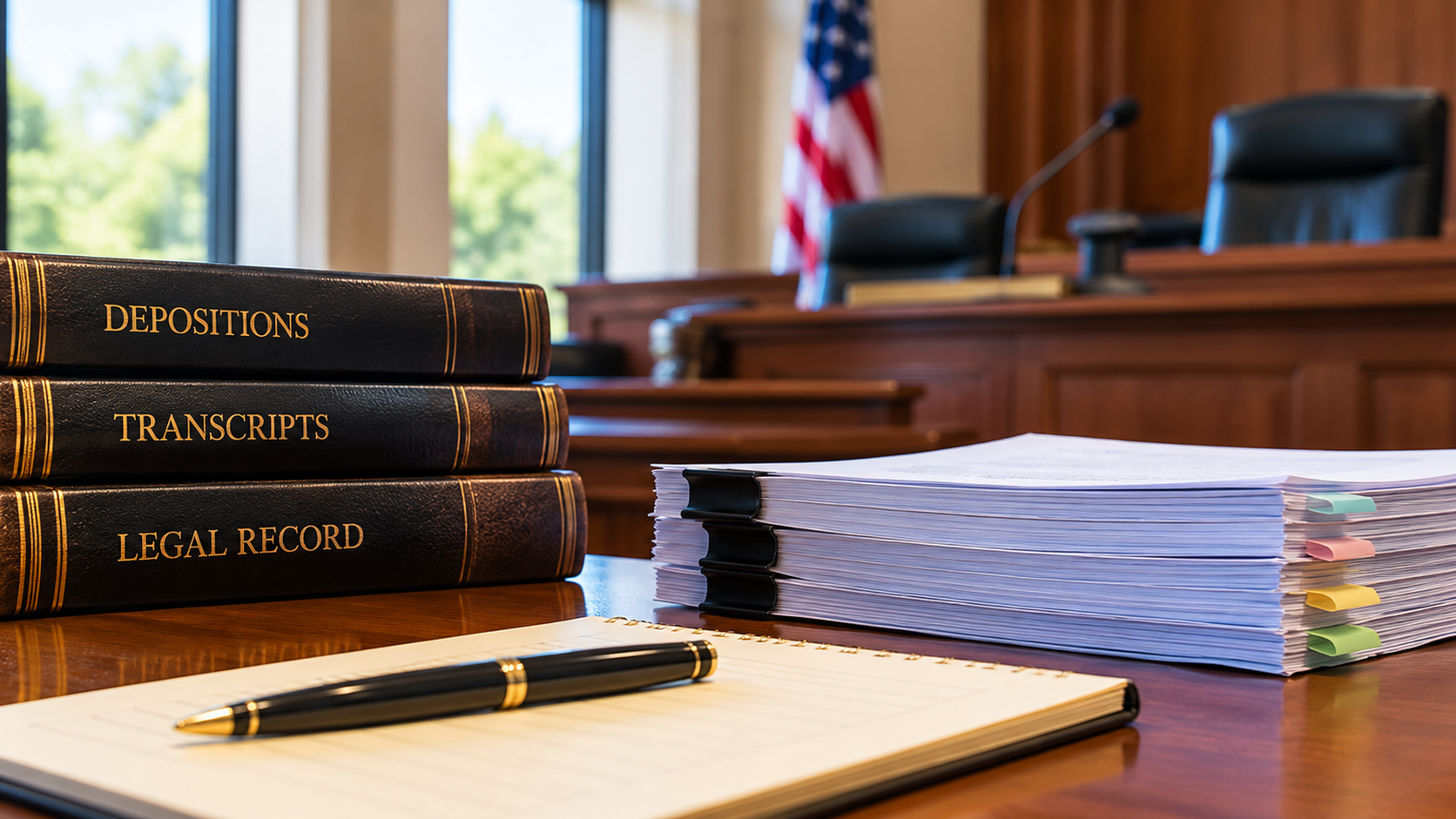
Court reporting is often associated with capturing the words spoken during a legal proceeding, but creating a useful record involves more than recording dialogue as it occurs. Testimony may unfold quickly, multiple people may participate in the same proceeding, exhibits may be introduced, unfamiliar terminology may arise, and speakers may occasionally talk over one another. Each of these elements can affect how clearly the proceeding is represented later.
The court reporter works within this environment while maintaining a record that can be reviewed after the proceeding has ended. Whether the setting is a deposition, hearing, trial, or another type of legal proceeding, the written record provides a structured account of what occurred. Understanding how that record is preserved helps explain why court reporting involves both the immediate capture of testimony and attention to the details surrounding it.
Capturing Testimony as It Happens
The foundation of the legal record is the testimony and dialogue that occur during the proceeding. Court reporters use specialized methods and equipment to capture spoken words as they are delivered, often while attorneys are asking questions, witnesses are responding, and other participants are speaking throughout the session.
This process requires sustained attention because spoken communication does not always follow a predictable rhythm. A witness may answer before a question has been completed, an attorney may interrupt to raise an objection, or several participants may begin speaking at approximately the same time. These moments can make the record more difficult to follow if the speakers and their statements cannot be clearly distinguished.
The mechanics behind this process are explored further in From Stenotype to Screen: How Realtime Court Reporting Works, which looks at how spoken language can be translated into readable text during a proceeding.
Identifying Who Is Speaking
A transcript needs to communicate more than the words themselves. A reader must also be able to determine who asked a question, who provided an answer, when an attorney made an objection, and when another participant entered the discussion.
Speaker identification becomes particularly important when several attorneys or parties are involved. While the people in the room can often recognize voices and understand the immediate context, someone reading the transcript weeks or months later does not have those same visual and conversational cues.
Clear identification throughout the proceeding helps preserve that context. It allows the eventual transcript to show not only what was said but how the discussion moved among the participants.
Maintaining Clarity During the Proceeding
The quality of a written record is influenced by what happens before the transcript is ever produced. Clear questions, verbal responses, accurate names, and orderly exchanges all contribute to testimony that can be represented more precisely.
For example, gestures such as nodding or pointing may be understandable to the people physically present but may not communicate the same information in a written transcript. Similarly, overlapping conversations can make it difficult to distinguish one speaker’s words from another’s.
This is one reason clear communication is important throughout a legal proceeding. The same issue frequently arises during depositions, where the relationship between spoken communication and the resulting record is discussed in Why Clear Communication Matters During a Deposition.
Keeping Exhibits Connected to the Record
Documents, photographs, diagrams, correspondence, and other materials can become important parts of a proceeding. When an exhibit is introduced, testimony may depend heavily on what a witness is reviewing or discussing at that moment.
Maintaining a clear relationship between the testimony and the referenced exhibit helps preserve the context of the exchange. Exhibit numbers or other identifying information can allow a later reader to understand which material was being discussed during a particular portion of testimony.
The process becomes especially important when numerous exhibits are introduced or when proceedings occur remotely. A closer examination of this process can be found in How Exhibits Become Part of a Deposition Record.
Handling Names and Specialized Terminology
Legal proceedings can contain names, locations, technical terminology, medical language, company names, abbreviations, and other terms that are not part of everyday conversation. Correctly identifying these terms can be important to the usefulness of the final record.
Context may help distinguish some terminology, while clarification during the proceeding can resolve uncertainty in other situations. Proper names can present their own challenges because different spellings may sound identical when spoken aloud.
These details illustrate why preserving the record is not simply a matter of capturing a continuous stream of words. The information must ultimately be represented in a form that accurately reflects the proceeding and can be understood by someone who was not present.
The Record Continues After the Last Question
When testimony concludes, the work associated with the written record may continue. The captured material can require review, formatting, speaker identification, terminology checks, and other preparation before it becomes a completed transcript.
This stage provides an opportunity to examine the record as a whole rather than only as a live sequence of statements. Questions and answers must remain properly organized, speakers must be represented consistently, and the structure of the transcript must allow readers to follow the proceeding.
The transition is examined more closely in From Testimony to Transcript: What Happens After the Proceeding.
Preserving Context for Later Review
One of the defining characteristics of the legal record is that it is created for use beyond the moment in which the proceeding occurs. Attorneys may return to testimony while preparing a case. Portions of a transcript may be reviewed to examine a witness’s earlier statements. Courts and other participants may need to reference what occurred during a previous proceeding.
The people using the transcript later may have little or no memory of the original setting. Some may not have attended the proceeding at all. The written record therefore needs to stand on its own as a structured representation of the testimony and related events.
That long-term purpose helps explain why details that appear minor during a live proceeding can become significant later. Speaker identification, clear responses, exhibit references, terminology, and the organization of testimony all contribute to a record that remains understandable after the proceeding has ended.
A Record Built Throughout the Proceeding
Preserving the legal record is not a single step performed after testimony concludes. It begins while the proceeding is underway and continues through the preparation of the written transcript. The clarity of the testimony, identification of participants, handling of exhibits, and attention to terminology all contribute to the final result.
Court reporters operate at the center of that process, connecting what occurs during a proceeding with the record that remains afterward. The result provides attorneys, courts, witnesses, and other participants with a way to return to the testimony long after the original conversation has ended.