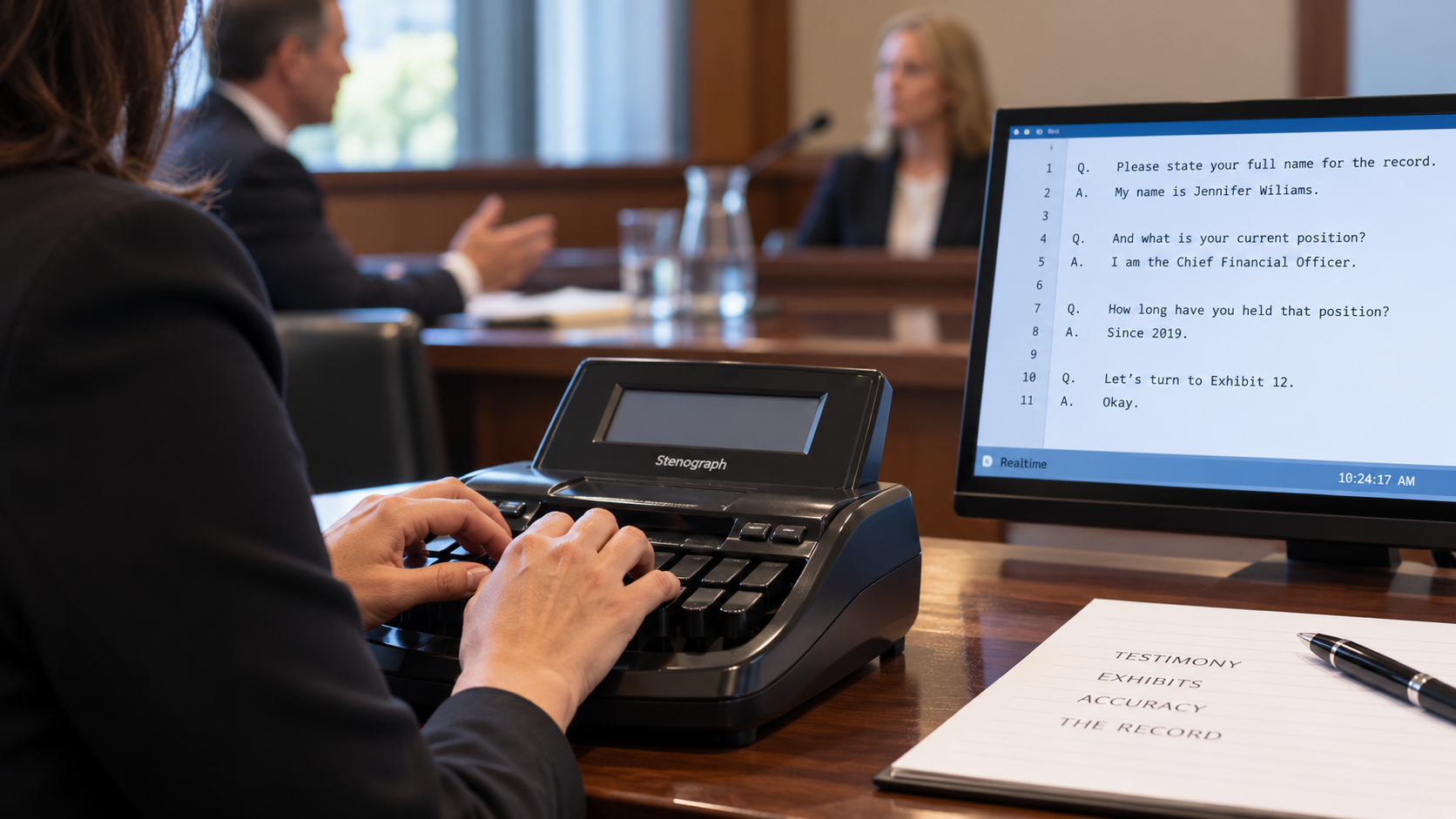
Spoken testimony moves quickly. A question can lead to a lengthy answer, an objection can interrupt the exchange, and unfamiliar names or technical terms may appear without warning. A court reporter follows that conversation as it occurs, but in some proceedings the reporter’s work can also be viewed almost immediately by others in the room.
This is realtime court reporting. Through a combination of stenographic writing, specialized software, and a reporter’s individual dictionary, spoken words can appear as readable text on a connected screen while testimony is still underway. What appears almost instantaneous to the viewer is the result of preparation, technical skill, and a writing system designed specifically for capturing speech at speed.
It Starts With the Stenotype Machine
A stenotype machine does not function like a conventional computer keyboard. Rather than entering individual letters one at a time, a reporter can press several keys together to represent sounds, syllables, words, and phrases. This allows language to be captured at the pace required during testimony.
Each combination of keys produces a stenographic stroke. Experienced reporters develop writing methods that allow common words and phrases to be represented efficiently, while specialized terminology can be incorporated into their working vocabulary. The process is closely tied to the work of a court reporter, particularly when testimony involves several speakers or moves rapidly from one subject to another.
What the reporter writes on the stenotype machine is only the beginning of the realtime process. Those strokes must then be translated into language that someone else can read.
Turning Stenographic Strokes Into Text
Court reporting software receives the reporter’s stenographic input and compares it with entries contained in a personalized dictionary. When a stroke corresponds with an entry, the software translates it into English text. That translation can appear on a computer or another connected display within moments.
The dictionary is an important part of this process because reporters do not necessarily write every word in exactly the same manner. Personal writing habits, abbreviations, phrases, names, and specialized terminology can all become part of an individual reporter’s system. As the dictionary becomes more refined, the software has more information available when interpreting the reporter’s strokes.
This relationship between reporter and software is one reason realtime should not be viewed as a simple automated conversion of audio into text. The technology is translating stenographic input produced by a trained reporter who is actively listening to and capturing the proceeding.
Seeing Testimony While It Happens
Once the stenographic strokes are translated, realtime text can be transmitted to authorized participants. Depending on the setup, an attorney may view the developing testimony on a laptop, tablet, monitor, or other connected device.
The practical result is unusual when compared with a traditional transcript. Instead of waiting until after the proceeding to read what was said, a participant can see portions of the testimony while the witness is still answering questions.
That immediate access can be useful during lengthy or detailed proceedings. An attorney may want to revisit the wording of an earlier answer or follow a complicated sequence of testimony. Realtime text provides another way to follow the proceeding while the legal record is still taking shape.
Where Realtime Reporting Can Be Used
Realtime reporting can appear in several legal settings. Depositions are one example, particularly when testimony is lengthy, technically complex, or being followed by attorneys in different locations. Realtime can also be used during trials, hearings, arbitrations, and other proceedings where immediate access to spoken testimony is useful.
The technology can be particularly helpful when a proceeding involves detailed terminology or a large amount of testimony. Being able to view text as it is produced gives authorized participants a written reference without requiring the proceeding to end first.
Remote proceedings have expanded the ways realtime text can be delivered. Participants may be located in different offices or even different states while still receiving the reporter’s translated text electronically. The physical distance between participants changes, but the reporter remains responsible for capturing what is spoken.
Preparation Matters Before Testimony Begins
Realtime work can begin well before the first question is asked. A reporter may receive case information, witness names, attorney names, technical terminology, or other materials that can assist with preparation. Reviewing those details provides an opportunity to add unfamiliar terms to the reporter’s dictionary before they arise during testimony.
Consider a proceeding involving medical testimony. Drug names, procedures, anatomical terms, physician names, and specialized abbreviations may appear repeatedly. An engineering dispute may involve equipment, measurements, technical processes, or product names. Proper names present their own challenges because identical pronunciations can have very different spellings.
Preparation does not mean every word that will be spoken can be anticipated. Testimony can move in unexpected directions. It does, however, give the reporter additional information that may improve how specialized language translates when it appears.
What Happens When the Software Encounters Something Unfamiliar
Not every stenographic stroke will immediately translate into the intended word. An unfamiliar name, unusual term, or stroke that is not recognized by the reporter’s dictionary may appear differently on the realtime display.
These untranslated or imperfectly translated portions are one reason the text appearing during a live proceeding should be distinguished from the finished transcript. Realtime provides immediate access to the reporter’s writing as it is being translated, but additional work can follow after testimony concludes.
The reporter can later review the record, resolve untranslated strokes, verify terminology, and perform the other steps involved in preparing the completed transcript.
Realtime Is Not the Final Transcript
The speed of realtime can make the text on the screen appear finished, but immediacy and final production serve different purposes. Realtime text is generated while the proceeding is actively taking place. A final transcript can receive additional attention after the last question has been asked, and the process of moving from testimony to transcript continues after the proceeding concludes.
Names may be checked, punctuation reviewed, formatting addressed, and portions of the record examined more closely. Requirements can also vary according to the type of proceeding and the circumstances surrounding transcript production.
The distinction is important. Realtime gives authorized participants rapid access to testimony. The completed transcript represents the prepared written record that follows the proceeding.
The Human Skill Behind the Screen
Realtime court reporting involves sophisticated technology, but the screen is only the visible end of the process. Before words appear there, the reporter has listened to the speaker, interpreted the sounds, written stenographic strokes, and continued following the conversation as new testimony arrives.
At the same time, the reporter may be distinguishing speakers, listening for objections, recognizing when clarification is needed, and keeping pace with terminology unique to the matter. The software supports that work by translating the reporter’s writing, but it does not replace the skill required to produce the stenographic input.
This becomes especially apparent during complicated exchanges. Multiple speakers can interrupt one another, witnesses can change direction in the middle of an answer, and attorneys can introduce unfamiliar subjects without advance notice. Realtime reporting has to continue through those moments because the proceeding itself does not stop.
A Different Way to Experience the Record
For much of court reporting history, there was a natural separation between hearing testimony and later reading the transcript. Realtime technology has narrowed that gap. The spoken exchange and its written representation can now exist almost side by side.
The stenotype machine captures the reporter’s writing. Software translates those strokes. Connected devices make the resulting text available to authorized viewers. Behind all of those components remains the reporter, following each question, answer, objection, and change in speaker as it happens.
That combination of human skill and reporting technology is what moves testimony from stenotype to screen.