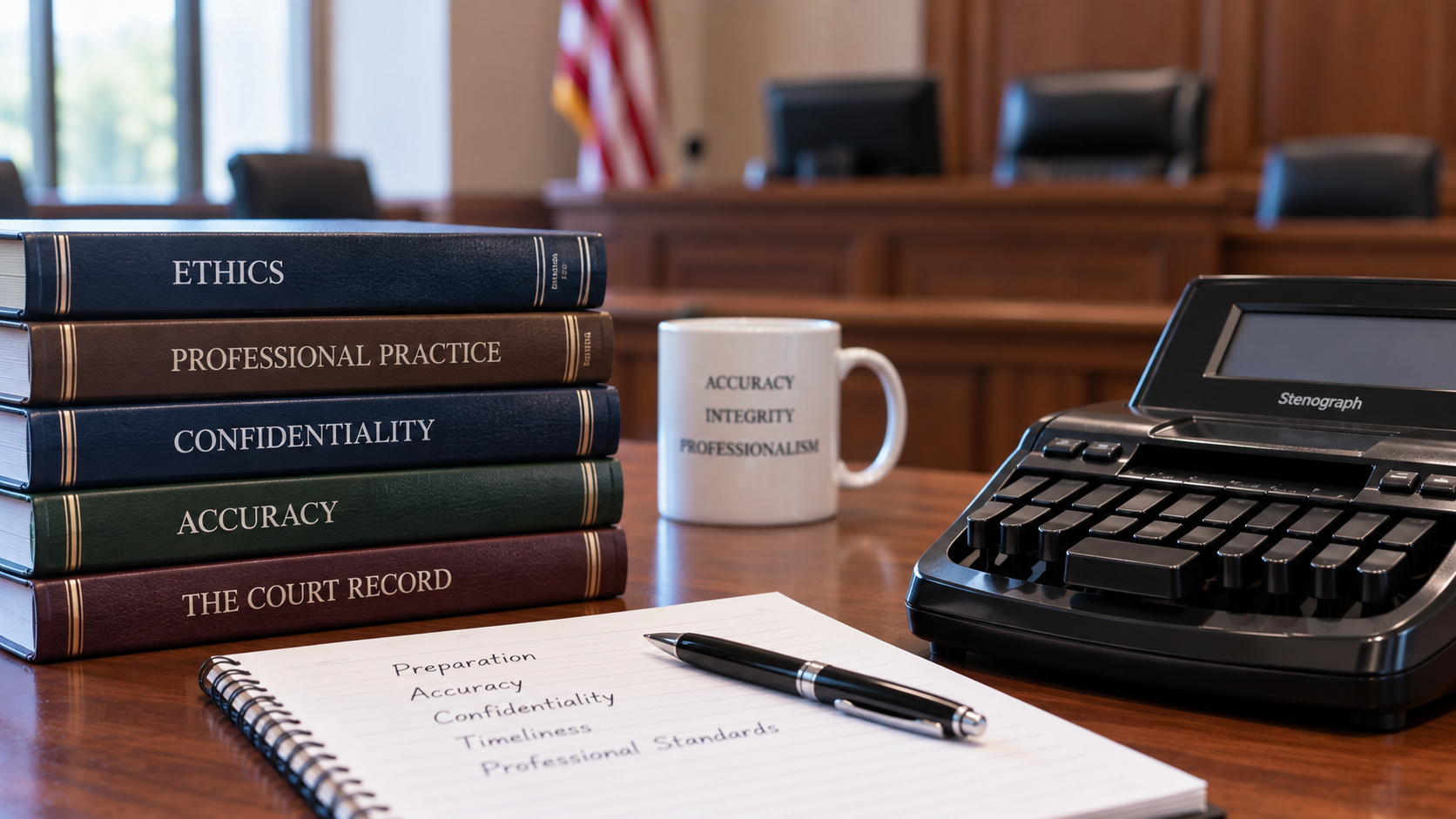
Accuracy is one of the most recognizable expectations associated with court reporting, but producing a dependable record involves more than capturing individual words correctly. A reporter works within a proceeding where speakers may interrupt one another, unfamiliar terminology can surface without warning, confidential information may be discussed, and testimony can continue for hours.
Professional standards provide structure for handling those circumstances. Some expectations arise from court rules, statutes, licensing requirements, certification programs, or professional codes. Others are reflected in the everyday practices reporters use to protect the integrity of their work. The exact requirements can differ by jurisdiction and assignment, but several principles are closely connected to the creation of a reliable record.
Accuracy Begins During the Proceeding
The quality of a transcript is influenced by what happens while testimony is being given. A reporter who cannot clearly hear a response cannot simply rely on what the witness probably intended to say. When speech is unclear, clarification may be necessary.
This can occur when participants speak simultaneously, a witness responds too quietly, or terminology cannot be heard clearly. Names and numbers can require particular attention because a small difference may change the meaning of the testimony. The reporter’s role is centered on what actually enters the record rather than assumptions about what someone meant.
That responsibility is part of the broader work of a court reporter and continues from the opening of a proceeding through preparation of the transcript.
Remaining Neutral to the Proceeding
Court reporters regularly work in matters where the participants disagree strongly with one another. Attorneys advocate for their clients, witnesses provide testimony, and judges or other decision makers may resolve disputes. The reporter occupies a different position.
The task is not to favor one side of an argument or influence the substance of testimony. The reporter is responsible for capturing the proceeding according to the requirements that apply to the assignment.
Neutrality also affects how the reporter interacts with participants. Questions about the substance of a case belong to the attorneys and other appropriate participants. The reporter’s involvement is directed toward the record and the practical requirements necessary to produce it.
Confidentiality Can Extend Beyond the Hearing Room
Legal proceedings can involve information that is private, sensitive, or subject to restrictions on disclosure. Business records, medical information, financial material, employment matters, personal details, and other forms of protected information may appear during testimony.
A reporter can encounter this material simply by performing the assignment. Professional handling of transcripts, exhibits, notes, and electronic files therefore matters beyond the hours spent in the proceeding itself.
The requirements governing confidentiality are not identical in every situation. Court orders, agreements, local rules, and the nature of the proceeding can affect how information must be handled. Reporters need to work within the requirements applicable to the matter rather than treating every assignment as though the same rules automatically apply.
The Importance of Speaker Identification
A transcript needs to communicate not only what was said but who said it. This sounds straightforward until several people begin participating in the same exchange.
A deposition may include multiple attorneys in addition to the witness. Hearings and trials can involve judges, attorneys, witnesses, interpreters, clerks, and other participants. When speakers interrupt or respond rapidly, keeping those voices distinct becomes increasingly important.
As discussed in our look at how the legal record takes shape, the reader of a transcript does not have access to all of the visual cues available to someone who attended the proceeding. Clear speaker attribution helps replace some of that missing context.
Preparation Supports Accurate Reporting
Preparation can vary considerably depending on the assignment. A reporter may receive a case caption, witness information, attorney names, pleadings, technical terms, or other material before the proceeding begins.
Reviewing available information can help identify terminology that may appear during testimony. This becomes particularly useful in matters involving medicine, engineering, technology, finance, or another specialized field.
Preparation is also valuable for realtime assignments. Names and specialized vocabulary can be added to a reporter’s working dictionary so that the software has better information available when translating stenographic strokes. Our discussion of realtime court reporting looks more closely at how the reporter’s writing and translation software work together during live testimony.
Technology Requires Careful Handling
Court reporting increasingly involves digital tools. Stenographic notes, audio used in accordance with applicable practices, transcript files, electronic exhibits, remote proceeding platforms, and realtime connections can all become part of a reporter’s working environment.
Convenience does not eliminate the need to handle those materials carefully. Devices, files, transmission methods, and storage practices can affect how information associated with a proceeding is managed.
Remote proceedings have added another dimension. Participants may join from separate locations, exhibits may be exchanged electronically, and testimony may travel through microphones, computers, and internet connections before reaching the reporter. Attention to the technical environment has therefore become part of maintaining a usable record.
Deadlines Are Part of the Assignment
Accuracy receives considerable attention in court reporting, but timeliness can also matter. Attorneys, courts, agencies, or other authorized parties may require transcripts within particular timeframes. Some situations can involve expedited requests.
Meeting a deadline does not change the need for careful transcript preparation. Instead, it affects how the reporter organizes the work that follows a proceeding.
Scheduling also matters before an assignment begins. Reporters may need to account for expected proceeding length, travel, remote access, realtime requirements, transcript requests, and other responsibilities when determining availability.
Standards Can Vary by Jurisdiction
Court reporting is not governed by one universal set of requirements that applies identically everywhere. States and courts can differ in their rules concerning licensing, certification, transcript formats, record retention, remote proceedings, and other aspects of reporting practice.
Different types of proceedings can also carry different requirements. Practices appropriate for a private deposition may not necessarily be identical to those required in a particular courtroom or administrative hearing.
For that reason, broad discussions of professional practice should not be mistaken for a substitute for the rules governing a specific jurisdiction or proceeding. Reporters and legal professionals need to know which requirements apply to the work in front of them.
Professional Practice Shows Up in the Finished Record
Many of the practices associated with court reporting are largely invisible to someone reading a completed transcript. The reader sees organized testimony, identified speakers, exhibits referenced in sequence, and a record that can be followed from page to page.
Behind that document are decisions and habits exercised throughout the assignment. The reporter prepared for the proceeding, followed the speakers, addressed unclear testimony when appropriate, managed reporting technology, and worked with the captured material after testimony concluded.
Professional standards are therefore not separate from the record. They are reflected in the way that record is created, handled, and ultimately presented.