The words court reporter naturally bring to mind a courtroom. A witness is on the stand, attorneys are at counsel tables, and a judge presides from the bench. Courtrooms are certainly one setting for the profession, but they represent only part of where reporting work takes place.
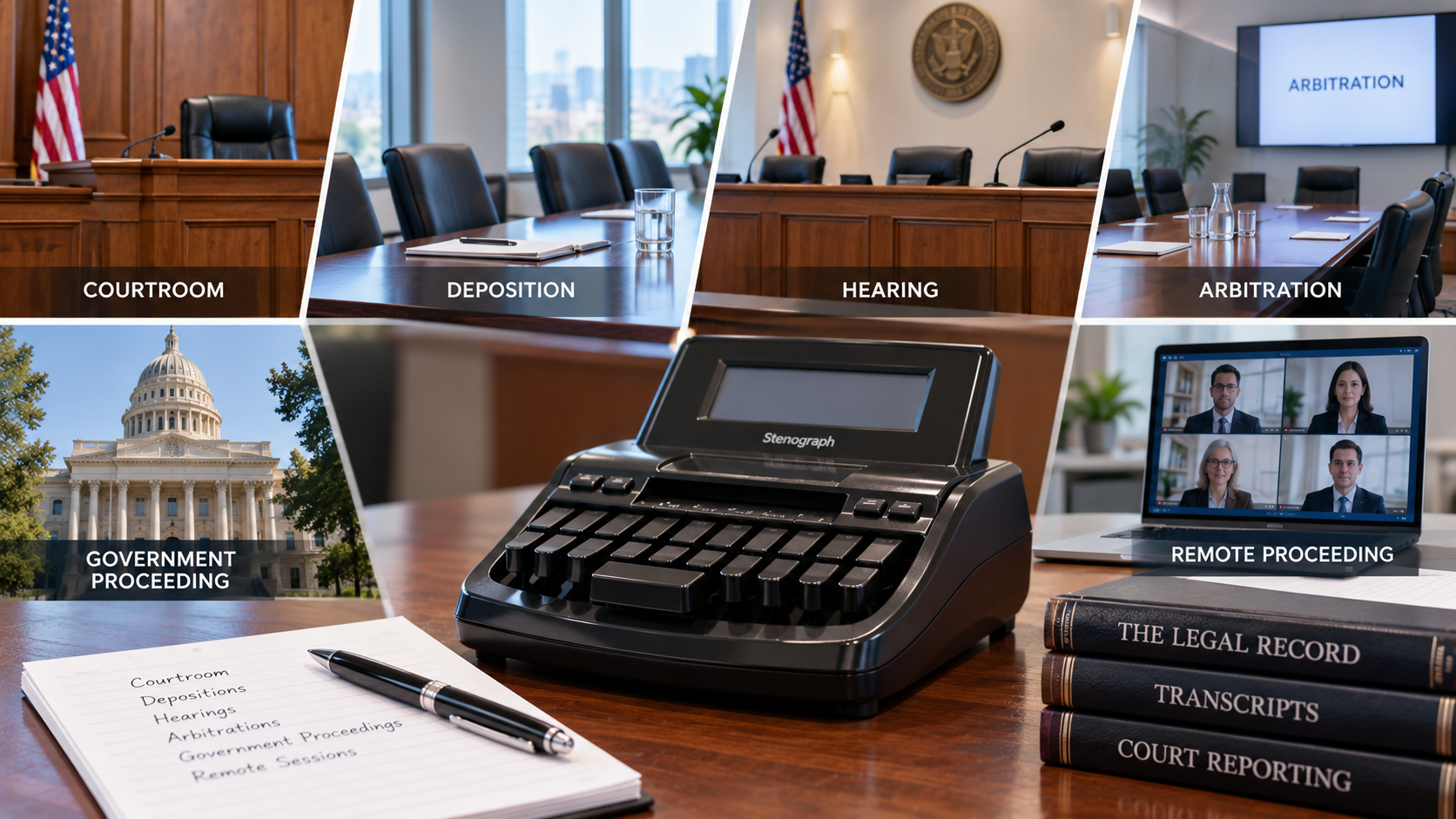
Court reporters can be present wherever an accurate record of spoken proceedings is required. That may mean a conference room during a deposition, an administrative hearing, an arbitration, a government proceeding, or a remote session connecting participants from several locations. Each environment has its own rhythm, participants, and practical demands, while the reporter’s responsibility remains centered on capturing what is said.
Depositions Often Take Place Outside Court
A large amount of reporting work occurs in depositions rather than inside a courthouse. Depositions are commonly conducted in law offices, conference rooms, reporting offices, or other professional settings. The surroundings may feel less formal than a courtroom, but the testimony being given is still part of a legal process.
The reporter follows questions, answers, objections, and references to exhibits as the examination progresses. Attorneys may move through documents, ask about dates or events, and return to earlier subjects as new questions arise. Several attorneys can participate, sometimes representing different parties with separate interests in the matter.
The setting may be a conference table instead of a witness stand, but many of the demands associated with the work of a court reporter remain present. Speakers need to be identified, testimony needs to be captured, and the proceeding needs to produce a record that can be reviewed afterward.
Inside the Courtroom
Courtroom reporting introduces a different environment. Proceedings may involve a judge, attorneys, witnesses, court personnel, jurors, and members of the public. The reporter must follow the portions of the proceeding that are placed on the record while activity continues throughout the room.
Trials are only one example. Depending on the court and jurisdiction, reporters may work with motions, evidentiary hearings, sentencing proceedings, conferences, or other matters. The pace can shift quickly as a witness finishes testifying, attorneys address the court, or the judge issues a ruling.
Courtrooms also have procedures and local practices that affect how the record is handled. The reporter needs to work within the requirements of the particular court rather than assuming that every courtroom operates in precisely the same manner.
Hearings Can Take Many Forms
The word hearing covers a wide range of proceedings. Some occur before judges, while others may take place before administrative officers, boards, agencies, or other decision makers. The subject could involve licensing, employment, regulation, benefits, professional discipline, or another matter requiring testimony and argument to be recorded.
A hearing may include formal testimony from witnesses as well as statements from attorneys or other representatives. Documents can be introduced, objections raised, and procedural questions discussed. The reporter follows these exchanges and identifies the speakers so the resulting record can be understood later.
Because hearing formats vary, preparation can be especially useful. Knowing the names of participants, the nature of the matter, and terminology likely to arise can help the reporter become familiar with the proceeding before it begins.
Arbitration Creates Its Own Reporting Setting
Arbitration takes place outside the traditional courtroom but can still involve detailed testimony and extensive exhibits. An arbitrator or panel hears the dispute, attorneys present their positions, and witnesses may be examined much as they would in other legal proceedings.
The physical setting is often a conference room or hearing facility. Some arbitrations extend across multiple days and involve substantial documentary evidence. Others may be relatively short. In either case, the reporter needs to follow the participants and capture the portions of the proceeding designated for the record.
The less formal surroundings do not necessarily mean the reporting assignment is less demanding. Complex commercial, technical, construction, financial, or professional disputes can introduce specialized vocabulary and lengthy testimony that require sustained attention.
Government and Administrative Proceedings
Court reporters may also work in settings connected with government agencies, commissions, public bodies, and administrative matters. These proceedings can differ considerably from conventional litigation, both in structure and subject matter.
A reporter might encounter prepared statements, testimony from several participants, public comments, technical presentations, or discussions involving agency officials. Depending on the proceeding, there may also be terminology drawn from regulation, science, medicine, finance, utilities, or another specialized field.
The format changes from assignment to assignment, but the basic challenge is familiar. Spoken information needs to be captured in a way that allows the proceeding to be reconstructed through the written record.
Remote Reporting Changed the Meaning of Location
Not every reporting environment now has a single physical location. Video conferencing has made it possible for the reporter, witness, attorneys, and other participants to join the same proceeding from separate places.
A remote deposition might involve a witness at home, attorneys in different offices, and a reporter working from another location entirely. The proceeding exists through the connection among those participants rather than around one conference table.
This arrangement introduces practical considerations that are less prominent during an in person assignment. Microphone quality, internet stability, background noise, camera positioning, speaker identification, and electronic exhibit handling can all affect how smoothly the session proceeds. When several people speak at once, the limitations of remote audio can make an already difficult exchange even harder to capture.
Technology Travels With the Reporter
The reporting environment has changed as the tools of the profession have become increasingly portable. Stenotype machines, computers, reporting software, realtime connections, electronic exhibits, and remote meeting platforms allow work to take place across a much wider range of settings.
Realtime capability is one example. As discussed in how realtime court reporting works, stenographic strokes can be translated into readable text while testimony is occurring and transmitted to authorized participants. That can be useful whether everyone is sitting in the same room or joining from separate locations.
Technology can change how the reporter connects with a proceeding, but it does not remove the need to follow speakers, recognize terminology, address unclear speech when appropriate, and keep track of what is happening on the record.
Every Environment Has Its Own Sound
One overlooked difference among reporting settings is simply how they sound. A quiet conference room creates different conditions from a busy courtroom. A remote session depends heavily on microphones and speakers. A large hearing room may place participants farther apart, while a smaller deposition may position everyone within a few feet of the reporter.
Accents, speaking volume, room acoustics, background conversations, equipment noise, and overlapping speech can all influence what the reporter hears. Even the placement of participants can matter when several people are taking part.
The physical environment therefore becomes part of the assignment. A reporter is not working with isolated words arriving under controlled conditions. The words are coming from real people in real proceedings, each with its own pace and circumstances.
Different Rooms, the Same Need for a Record
Court reporting is defined less by a particular room than by the need to preserve spoken proceedings. The setting might contain a judge’s bench, a conference table, an arbitration panel, or simply a collection of faces on a computer screen.
Across those environments, the fundamental purpose remains recognizable. Testimony is given, participants speak, exhibits may be introduced, and the legal record takes shape as the proceeding moves forward.
The courtroom may provide the profession with its name, but court reporting reaches considerably farther than the courtroom door.